

NOT THE WORST DAY
Sean P. Hotchkiss
1
2
3
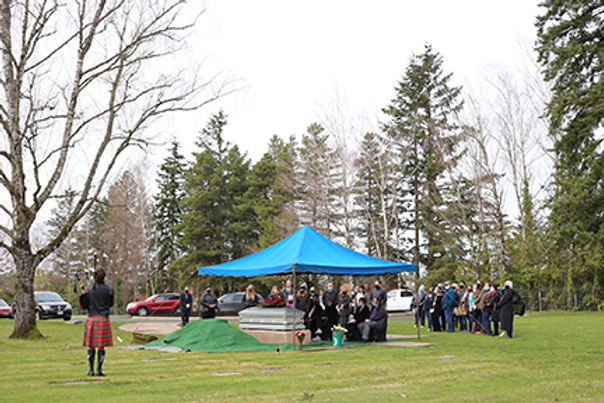
Fig. 1 Funeral by Robert Hotchkiss
Stop for a moment and look at the photograph before you proceed.
Okay, that should be long enough.
It is an overcast day, a gray day, but still light. There is a red and gray kilt-clad bagpiper standing on a field of grass in the bottom left corner with his back to us. His stance gives the impression he is playing. The grass is well groomed with hues of yellow and green mixed in. There is a blue canopy in the center of the photo, sheltering a closed silver-trimmed gray casket that lies upon what looks like a bronze-hued pedestal. The pedestal is actually the bottom of a grave box designed to protect it from water damage, but the casual observer would not know this. A couple lines of grave markers are set into the earth in the foreground that may not be immediately visible. There is an astroturf-covered mound behind the casket, presumably covering the dirt that has been displaced by the digging of the grave. Lying flat on the grass are several plywood panels. A large bouquet of beautiful red roses lies atop the casket and a green University of Oregon bucket with white and yellow roses sits beside it. Also nearby is a small vase of red and white flowers.
In the background there are a mix of large evergreen and deciduous trees with a line of cars parked in front of them. The deciduous trees are leafless, adding to the starkness of the image. Two distinct groups of people stand in a rough semi-circle around and behind the canopy, with a few lone people standing apart. Most are wearing black, but there is a splash of pink, green, brown, or blue here and there. Everyone is wearing a mask to protect themselves and others from Covid-19. Upon closer inspection you see four people seated close to the casket with a space in between them. Two, a man and a young woman, are on one side, and two more, a young woman and a young man, are on the other. It appears that the people are either listening to the piper, lost in silent contemplation, gazing at the casket, or all three as no one seems to be speaking. Most appear to be looking in the same direction.
What did you think of when you first saw the image? How did you feel? Did any memories or images from your past surface? Were there any imaginings of what the future may have in store for you or your family?
Even without the casket being so prominent, it is easy to tell that the photograph has captured a funeral in progress. The somber gray sky, the grass, and the mix of evergreens and deciduous trees are classic signs that this photo was taken in the Pacific Northwest. The canopy, seeming out of place with its bright blue color, is unaware that it is pulling focus away from the other details in the picture. It is only there to fulfill its purpose of protecting what is underneath from potential rain. The lack of leaves on the trees tells us it must be winter. The University of Oregon bucket leads to the conclusion that at least one person in attendance is a Ducks fan and may narrow down where the photo was taken, Oregon. All the masked faces show that the funeral is taking place during the Covid-19 pandemic. Perhaps this death was another casualty of the virus. Seen are friends and family paying their last respects to a loved one. Presumably grieving would be a unifying catalyst, but cliquish groups, reminiscent of a poorly-themed high school dance, have formed. It’s unclear if these groups were formed because of a rift, a coincidence, or social distancing.
While it is expected to see black formal wear at a funeral, reality leaks into this photograph contrasting what is seen in a movie or television show. If this were a staged ceremony, everyone would be in almost-matching black suits and dresses. The splashes of color or the blue jeans would be absent. This must be a real event—with people present having different stories. This must be a real event—someone is in the casket. This must be a real event—someone is in pain. The four seated people are likely to be the closest friends or family of the deceased. Who else would rate such an unwelcome honor? Who are they? Who did they lose? Who was this person being honored by this group willing to risk their health by gathering? How this photo affected you, if it did, might depend upon your own personal experiences. It may be easy to make some assumptions about aspects of this image based on where we live and what is currently going on in our lives right now. Perhaps your observations and conclusions were similar to what has been described so far. Perhaps they were different.
Often, I think our reactions to and interpretations of photos are impacted by our level of separation from what is depicted. This photograph of a funeral could be interpreted differently by those who have or have not attended one. Differently still if the funeral was for someone you were close to. And even differently still if someone you love is very old or infirm. To what extent did your own memories and experiences shape what you saw and how you felt? Our interpretations might not reflect the reality of the photograph, or the timeline of events to the left and right of it.
The truth behind the photograph is that it was taken by my brother at my wife’s funeral—freezing, forever in time, a single frame of the terrestrial end of a wonderful story. She passed away and was laid to rest in January of 2021 after bravely and tenaciously battling cancer for almost a year. The image was captured as the Piper played “Amazing Grace” to a grieving and tearful audience towards the end of the service. The four people seated under the canopy are me and our children. We had just finished honoring my wife with our words and stories of love and loss and hope. As I write this, it occurs to me that the closeness of the relationship each person had with my wife can be gauged by their distance from the casket. The two groups that formed are primarily segregated by my wife’s people, who we call the “Out-laws,” on the right, and “my people” on the left. We named them the Out-laws because they are the family of my wife’s brother-in-law, so not “in-laws” themselves; therefore, “Out-laws.” The man in the suit closest to the pavement is the minister and the other two lone mourners are friends of my kids. My wife and I had ended up staying closer to my people, so the distance between the groups may reflect that. My wife is a Ducks fan and the bucket was her constant gardening companion. To some, it may seem just as out of place as the blue canopy, but not to me.
So now that you’ve read an interpretation of the photograph and have heard some of its story, how much have your thoughts and feelings changed? Are your perceptions and perspectives different now that we are at a different point in time? You may wonder, how could this not be someone’s worst day?
This picture cannot convey the emotion I and the others attending are feeling; that can only be left to the imagination, informed by interpretation and context, of the viewer. For me, examining this photograph so closely has been deeply interesting, frequently tearful and painful, and hopefully a little healing. There are things that I noticed for the first time, some of it pointed out by others. Such as the unanticipated segregation of the crowd, the ashen sky, and how the artificial blue of the canopy seems unfit for the occasion. This photograph is of one of the worst days of my life, but what it does not show, can’t show, is that the day after was worse. The thirty years prior to the snapping of this photo had been spent getting to know, marrying, loving, and being loved by my wife. The year prior had been spent caring for her, helping her fight the cancer that would take her from me. The days prior were spent making preparations for her memorial and funeral. The day after, there was nothing more I could do, or needed to do for her—except tell her story.
Sean P. Hotchkiss
Sean P. Hotchkiss was born and raised in the Portland Metro area of Oregon. He is a proud father of three, grateful partner of one, and widower. He recently rediscovered his love of writing after returning to college after three gap-decades. Sean is in his last term towards earning an A.A.S. in Business Marketing at Portland Community College (PCC) with plans to pursue a Master’s degree in clinical mental health. In addition to his “day job” as a digital marketer, he is also a reading and writing tutor at PCC.
He believes he does his best work where thought meets inspiration, and seeks out those things and people that stimulate both.
You can engage with Sean on Instagram @sphotch_the_writer or on his website at https://www.sphotch.com.
